|
|||
|
|
|
|
| Please visit the International Union of Geological Sciences (IUGS) Initiative on Forensic Geology (IFG) website for more recent activity.
|
|||
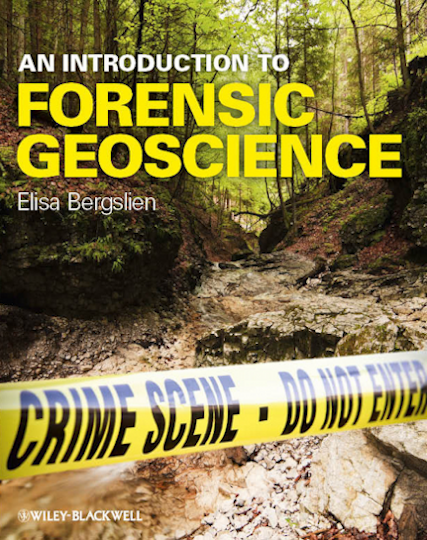
PublicationsBooksBergslien, E. (2012) An Introduction to Forensic Geoscience. Wiley-Blackwell. John-Wiley & Sons, Ltd.Peer-Reviewed PublicationsBergslien, E.T. (2018) Portable X-ray fluorescence (PXRF) spectrometry of earth materials: considerations for forensic analysis: In Fitzpatrick, R.W. & Donnelly, L. (eds): Forensic Soil Science and Geology, Geological Society, London, Special Publications (in press). Bergslien, E.T. (2013) X-ray diffraction (XRD) and field portable x-ray fluorescence (XRF) analysis and screening of soils, project design: In Dawson, L. and Pirrie, D. (eds) SP384: Environmental and Criminal Geoforensics, Geological Society, London, Special Publications, 384, pp 273. Engelbrecht, W., Bergslien, E.T., Miller, R. and Bush, P. (2009) A Lead object from the Eaton Site, The Bulletin: Journal of the New York State Archaeological Association, 124, 69-77. Bergslien, E.T., Bush M. A. and Bush, P.J. (2008) Identification of cremains using x-ray diffraction spectroscopy and a comparison to trace element analysis, Forensic Science International, 175(2), 218 – 226. doi:10.1016/j.forsciint.2007.07.004. Bergslien, E.T. and J.C. Fountain (2007) Examining the utility of epoxy replicas of single, natural fractures in dolostone for visualization experiments, Hydrogeology Journal, 16(1), 43-53. Bush, P.J., Bergslien, E.T. and Bush, M.J. (2007) Commentary on: Elemental Analysis of Human Cremains Using ICP-OES to Classify Legitimate and Contaminated Cremains. J Forensic Sci 2006; 51(5):967-73. Journal of Forensic Science, 52(3), 742, doi:10.1111/j.1556-4029.2007.00447. Bergslien, E.T. and J.C. Fountain (2006) The effect of changes in wettability on two-phase saturated flow in horizontal replicas of single natural fractures, Journal of Contaminant Hydrology, 88(3-4), 153-180. Bergslien, E.T. (2006) Teaching to avoid the CSI effect: Keeping the science in forensic science, Journal of Chemical Education, 83(5), 690-691. Bergslien, E.T., Fountain, J.C. and Giese, Jr. R. (2004) Characterization of the surface properties of epoxy-type models used for multiphase flow studies in fractured media and creation of a new model, Water Resources Research. Vol. 40 (5), W05112. PresentationsBergslien, E.T. (2018) Urban Soil and the Ethics of Disclosure. Resources for Future Generations 2018, Vancouver, BC, Canada, June 16-21. Bergslien, E.T. (2017) Tracking Heavy Metals in the Field: Issues with Portable x-ray fluorescence (PXRF) Spectrometry of Soils. Geological Society of America, Geological Society of America Abstracts with Programs. Vol. 49, No. 2. Drennan, C.A. and Bergslien, E.T. (2017) Testing for Metals Within the Soil and the Water Along the Buffalo River. Geological Society of America, Geological Society of America Abstracts with Programs. Vol. 49, No. 2. Bergslien, E.T. (2016) Portable X-ray Fluorescence (PXRF) Spectrometry of Soils: Method Limitations. 35th International Geological Congress, Fifth International Conference on Criminal and Environmental Soil Forensics Cape Town, South Africa, August 27–September 4. http://www.americangeosciences.org/information/igc abstract 5118 Bergslien,E.T. (2014) Small-scale spatial variability of soil in a managed urban environment. Forensic Geoscience: Future Horizons. Geological Society of London, 3 December, Piccadilly, London. Bergslien, E.T. (2012) Geochemical analysis of cremated human remains. Geological Society of America Abstracts with Programs, Vol. 44, No.7, p.192. Bergslien, E.T. (2012) X-ray diffraction (XRD) and x-ray fluorescence (XRF) analysis of cremated human remains. 2012 Geological Association of Canada (GAC) and Mineralogical Association of Canada (MAC) Joint Annual Meeting, St. John's, Newfoundland and Labrador, Abstracts, Vol. 35, p. 10. Bergslien, E.T. (2010) An examination of x-ray fluorescence (XRF) and x-ray diffraction (XRD) analysis of soils and the transfer issue. 3rd International Workshop on Criminal & Environmental Soil Forensics, 2-4 November 2010, Long Beach, California, USA. Bergslien, E.T. (2008) Field Portable X-ray Fluorescence (FPXRF) spectrometry of soils and the transfer issue, FGG 2008 Geoscientific Equipment & Techniques at Crime Scenes. The Geological Society (London), Forensic Geoscience Group. (Invited) Bergslien, E.T. and A. Hovey (2007) Differentiating soils in western New York using XRF and XRD to build a database, Geological Society of America Abstracts with Programs, Vol. 39, No. 6, p. 458. Gerovac, C.M. and E.T. Bergslien (2007) Forensic and environmental analysis of lead distribution in Erie and Niagara County soils, Geological Society of America Abstracts with Programs, Vol. 39, No. 6, p. 458. Engelbrecht, W. and E.T. Bergslien (2007) Enigma of a lead tooth: composition of lead items from the historic phase of the Eaton Site, Geological Society of America Abstracts with Programs, Vol. 39, No. 6, p. 29. Klinshaw II, R.J., G.D. Smith and E.T. Bergslien (2007) Spectroscopic geo-sourcing of lapis lazuli used in artists’ pigment production, Geological Society of America Abstracts with Programs, Vol. 39, No. 6, p. 30. Bergslien, E.T. (2006) Application of Field Portable X-ray Fluorescence (FPXRF) Spectrometry in Forensic and Environmental Geology. December 20th, 2006, Geoscientists at Crime Scenes, Geological Society of London. INVITED Bergslien, E.T. (2006) XRD and cremated human remains: what is in this urn anyhow?, GSA Abstracts with Programs, 38(7). Bergslien, E.T. (2006) X-ray diffraction identification of geologic trace evidence: in the classroom and for the courtroom, GSA Abstracts with Programs - Northeastern Section, 38 (invited speaker) Bergslien, E.T. (2006) Rocks, Soil and Bones: Characterization of Geologic Trace Evidence. November 2nd, 2006, Edinboro University, guest of Sigma Gamma Epsilon and the EUP Geosciences Department. Bergslien, E.T. (2005) Forensic use of x-ray diffraction for the identification of geologic trace evidence. November 29th, 2005, Western New York American Chemical Society Section. Bergslien, E.T. (2005) Forensic geology: an uncommon approach to rocks, minerals and maps, GSA Abstracts with Programs, 37 (7). Bergslien, E.T. (2005) Farmersville Landfill Saga: Geoscience and the Law, GSA Abstracts with Programs, 37 (7).
Research AreasForensic Geoscience; Low-Temperature Geochemistry; hydrogeology; transport and behavior of contaminants in the environment; non-aqueous phase liquids (NAPLs); clays; forensic geologyFor the past several years, my research has been concentrated on the analysis of soil samples for environmental and trace evidence/forensic purposes, and on study of the elemental composition and crystalline structure of cremains and skeletal material, I have been honing my skills in x-ray analysis as well as learning some of the fundamentals of SEM-EDS. A large component of my research is geared specifically towards development of appropriate protocols and best-practice approaches for x-ray analysis of a range of materials and under a range of conditions. Techniques in non-destructive analysis are a key area of interest to me. Non-aqueous phase liquids (NAPLs) are among the most common groundwater contaminants. Due to their low solubilities in water, NAPLs travel through the subsurface as separate liquid phases, resulting complex multi-phase clean-up problems. Their behavior in porous media and potential methods of remediation, have been the subject of active research for the past decade. However, the characterization of NAPL flow in fractured rock has lagged behind, and the potential effectiveness of remediation techniques remains unclear. The primary reason for this uncertainty is an insufficient understanding of the basic parameters controlling NAPL flow and distribution in natural fractures. While it is generally understood that flow and distribution of NAPL within single natural fractures are controlled by aperture distribution and connectivity, little experimental work has been done to characterize these attributes. Using translucent polymer casts of single natural fractures it is possible to determine aperture and actively record flow using a digital camera. Because plastic polymers have significantly different wetting characteristics than natural rock, the surfaces of the replicates must be altered using a Radio Frequency Glow Discharge Plasma treatment.
|
|||

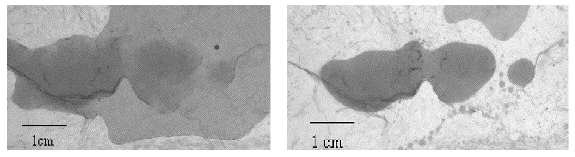
Figure 1. Comparison of NAPL (dark fluid) injected into water-saturated
untreated (left) and RFGD plasma treated (right)
plastic replicas.
untreated contact angle ~65 degrees.............treated contact angle ~35 degrees
|